
DATE
January 13, 2026
Cybersecurity remained a material operational and financial risk for law firms throughout 2025. Firms across multiple regions experienced ransomware, data theft, business email compromise, and third-party breaches that disrupted legal work, affected client relationships, and increased regulatory and insurance scrutiny.
The impact of these incidents was not limited to IT systems. Many firms faced weeks of operational disruption, delayed billing, and elevated legal and compliance costs. In parallel, the use of AI-assisted social engineering and voice-based fraud added a new layer of complexity to already strained security controls.
The ikPin™ 2025 Global Legal Cybersecurity Index brings together law enforcement reporting, threat intelligence, and financial modeling to provide a clear view of how cyber risk affected the legal sector in 2025. The purpose of this report is to help managing partners, CISOs, and risk committees understand where exposure exists and how it should be addressed going into 2026.
This report draws on publicly available and widely trusted cybersecurity and law enforcement intelligence, including the Verizon Data Breach Investigations Report 2025, CrowdStrike Global Threat Report 2025, Interpol cybercrime reporting, and breach cost and incident response data from leading industry sources. These datasets provide insight into ransomware prevalence, credential abuse, social engineering, third party exposure, and the financial and operational impact of cyber incidents.
Because cyber incidents in the legal sector are frequently handled confidentially and disclosure obligations vary by jurisdiction, many law firm breaches never enter public reporting. The analysis and financial models in this Index therefore combine verified global data with conservative legal sector assumptions to estimate operational disruption, revenue exposure, and governance risk. The results should be interpreted as representative indicators of risk rather than an exhaustive accounting of every incident.
Ransomware remained present in roughly four out of ten confirmed breaches across global datasets in 2025. Unlike earlier years, most ransomware operations now focus on data theft and extortion rather than encryption alone. Law firms are uniquely vulnerable because client files, litigation strategy, and financial documents provide high leverage.
BEC continued to generate some of the highest direct financial losses. Attackers compromised or spoofed law firm email accounts to alter wire instructions, impersonate partners, and manipulate settlement and property transactions.
Nearly one third of breaches in 2025 involved third parties. Law firms increasingly depend on cloud document systems, MSPs, e-discovery platforms, and virtual data rooms. A compromise in any of these systems exposes multiple firms and their clients.
Voice phishing and deepfake impersonation grew rapidly in 2025. Attackers used AI-generated voice and context to impersonate partners, clients, and regulators. This bypassed email security and exploited the legal sector’s reliance on trusted voice communication.
Across ransomware and major breach cases, two to four weeks of meaningful disruption became a realistic baseline in 2025. Even when systems were restored quickly, firms faced:
Legal workflows are highly interdependent. A failure in identity, email, or document systems ripples through every practice group.
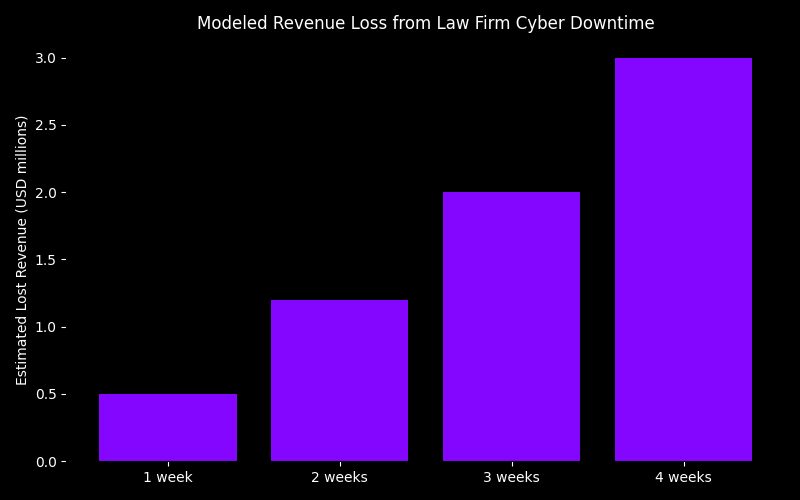
Using conservative mid-size firm assumptions, cyber downtime produces measurable financial loss.
A firm with 75 fee earners billing an average of 6 hours per day at $350 dollars per hour generates approximately $787,500 dollars per week.
Modeled impact:
This does not include reputational damage or lost future matters.
Cyber incidents in 2025 increasingly triggered:
Firms found that cyber incidents were treated not as IT events but as risk governance failures.
The most common breach drivers in 2025 were:
Technology was rarely the weakest link. Identity and governance were.
Firms that minimized damage shared key traits:
The legal sector operates in a high-threat environment. AI-driven social engineering, data-centric extortion, and supply chain risk will continue to intensify. Cybersecurity must be governed as a business discipline.
Legal organizations that treat cybersecurity as a background IT function will continue to face outsized financial and reputational risk. Those that treat it as a governed operational capability will be positioned to grow, retain clients, and defend themselves when incidents occur.
At ikPin™ we help law firms and regulated professional organizations translate global threat intelligence into risk models, readiness programs, and governance frameworks that are actionable.