DATE
December 15, 2025
Cybersecurity cannot be approached as a one time project or a checkbox exercise for law firms. It requires ongoing attention, clear ownership, and the ability to adapt as risks change. As cyber incidents affecting legal practices continue to rise, firms are being forced to rethink how they demonstrate trustworthiness. Reputation and legal expertise still matter, but so does the ability to consistently protect sensitive information.
In response, many law firms are turning to established security frameworks to bring structure to how they protect their environments. These frameworks are not about chasing certifications. They are about creating a shared understanding of risk, responsibility, and control across the firm.
Security frameworks provide a practical starting point for firms that want to move beyond informal practices. They help translate abstract risk into concrete actions. For law firms, this can mean clarifying who owns security decisions, defining how sensitive information is handled, and ensuring that controls are applied consistently across systems, offices, and vendors. Frameworks also create a common language that leadership, IT teams, and external partners can use when discussing risk. Most importantly, frameworks help firms avoid the trap of reactive security. Instead of responding to incidents one at a time, firms can take a more deliberate approach to identifying what matters most and protecting it accordingly.
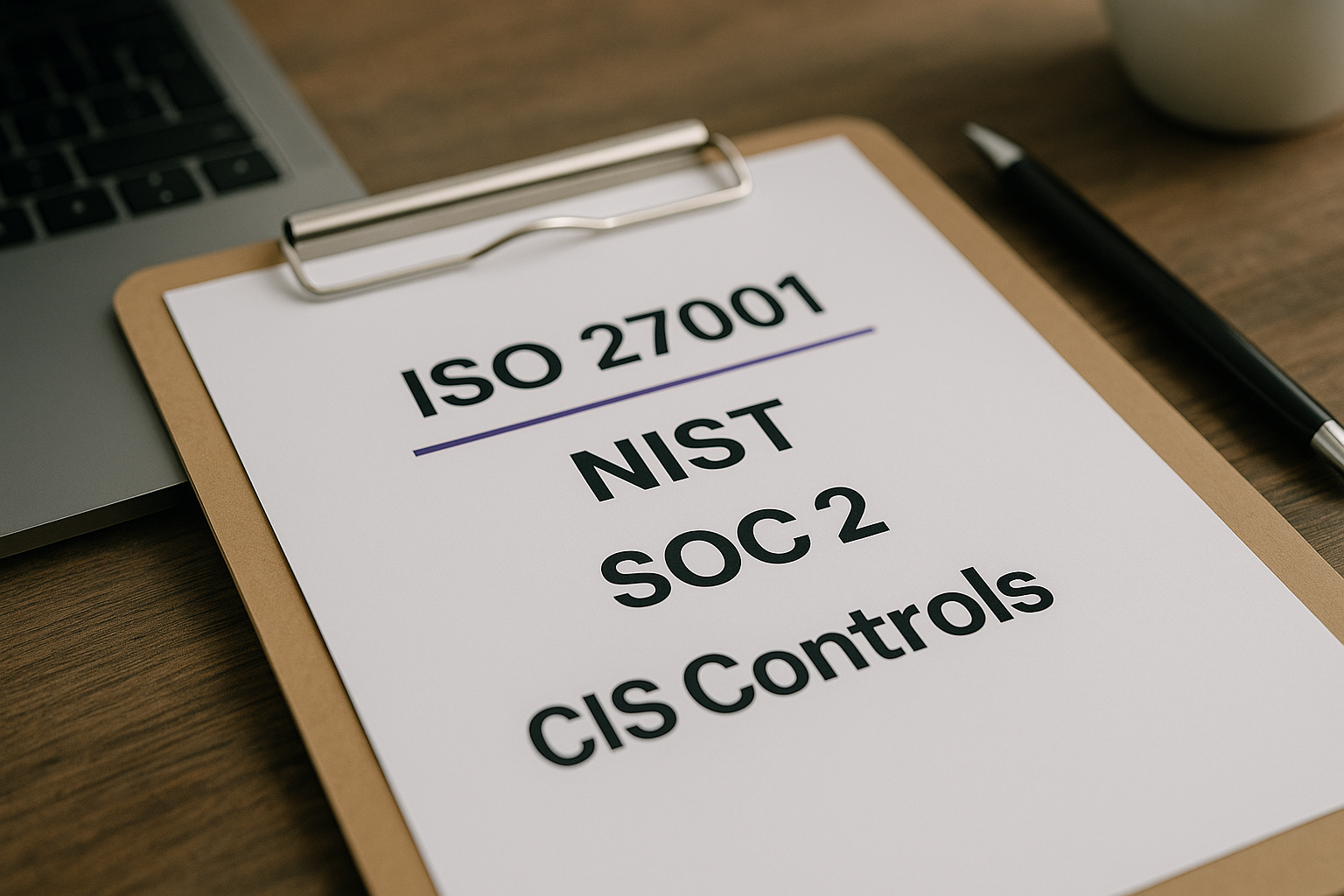
There is no single framework that works for every law firm. Different frameworks serve different purposes depending on a firm’s size, risk profile, client base, and regulatory exposure. Some of the more commonly used international frameworks include:
ISO 27001
A comprehensive information security management framework focused on risk based governance, documented controls, and continuous improvement. Often used by firms that want a structured and auditable approach to managing information security.
NIST Cybersecurity Framework
A flexible framework designed to help organizations identify, protect, detect, respond to, and recover from cyber incidents. Frequently used as a starting point for establishing baseline security practices.
CIS Critical Security Controls
A prioritized set of technical and operational controls intended to reduce common cyber risks. Often adopted by firms looking for practical guidance on where to focus security efforts first.
SOC 2 Trust Services Criteria
A reporting framework centered on controls related to security, availability, confidentiality, and privacy. Commonly referenced in client due diligence and vendor assessments.
COBIT
A governance focused framework that helps organizations align IT and security practices with broader business objectives. More often used by larger firms with complex operational environments.
In practice, many law firms use elements from multiple frameworks rather than adopting a single one in isolation. The most effective approach is typically one that reflects how the firm actually operates and evolves as risks and expectations change.
Not all frameworks provide the same level of structure. Some are intentionally high level, offering guidance without prescribing how controls must be implemented. Others are more formal, emphasizing documentation, ownership, and continuous oversight.
Many law firms begin with lighter weight frameworks to establish foundational practices around access control, incident response, and vendor management. These approaches can be effective, particularly for firms early in their security journey.
Over time, however, some firms find that these frameworks leave important gaps. They may describe what good security looks like, but not how it is governed, measured, or sustained.
This is where more structured frameworks such as ISO 27001 can play a role.
Rather than focusing only on individual controls, these frameworks emphasize how information security is managed as a system. They require firms to define scope, assess risk, assign ownership, document decisions, and review outcomes on a regular basis.
For law firms, this approach aligns well with how legal organizations already think about accountability, documentation, and risk management. It also helps ensure that security efforts are not dependent on a single individual or team, but embedded into how the firm operates.
More structured frameworks do not replace other approaches. They can build on existing practices, adding rigor where it is needed.
The growing interest in security frameworks reflects a broader shift in how law firms view cybersecurity. It is no longer treated solely as a technical issue, but as an operational and strategic one that directly affects client relationships.
Clients are paying closer attention to how their information is protected, particularly in regulated industries and high value matters. Security questions are appearing earlier in procurement conversations, during panel reviews, and as part of ongoing due diligence. In some cases, a firm’s ability to clearly explain its security posture can influence whether it is shortlisted at all.
In this environment, frameworks provide more than internal guidance. They give firms a structured way to demonstrate that security is being managed deliberately and consistently. Rather than relying on informal assurances, firms can point to defined processes, ownership, and risk management practices that clients can understand and evaluate.
More mature frameworks, such as ISO 27001, can further support this by providing a common reference point during client discussions. They help reduce friction in security reviews, speed up questionnaires, and build confidence that security is embedded into how the firm operates rather than dependent on individuals.
For many firms, this creates a tangible business benefit. Security frameworks become not just a defensive measure, but a way to support growth by meeting client expectations and strengthening trust at the outset of a relationship.
One common mistake firms make is treating frameworks as ends in themselves. Adopting a framework without understanding why it is being used rarely improves security.
The goal is not to check boxes or collect documentation. The goal is to reduce real risk in a way that makes sense for the firm’s size, practice areas, and client base.
Frameworks are most effective when they are adapted thoughtfully and revisited as the firm evolves. Security, like the legal profession itself, is not static.
There is no single framework that fits every law firm. What matters is choosing an approach that brings clarity, consistency, and accountability to how security is managed.
For some firms, that may begin with foundational guidance. For others, it may involve adopting a more comprehensive framework such as ISO 27001 to support long term resilience, regulatory alignment, and client confidence.
This is where we help. Through our compliance offerings, including Compliance as a Service and advisory support, we work alongside firms to identify the right framework based on their size, risk profile, and client expectations. Beyond selection, we help firms implement controls in a practical way and maintain them over time so compliance does not become a one time exercise or an annual scramble.
Cybersecurity cannot be left to chance. Firms that take a structured, ongoing approach to managing risk are better positioned to protect their clients, their reputation, and their future.